Left Behind by Design: The Human Cost of Deploying Technology Faster Than Your People Can Learn It
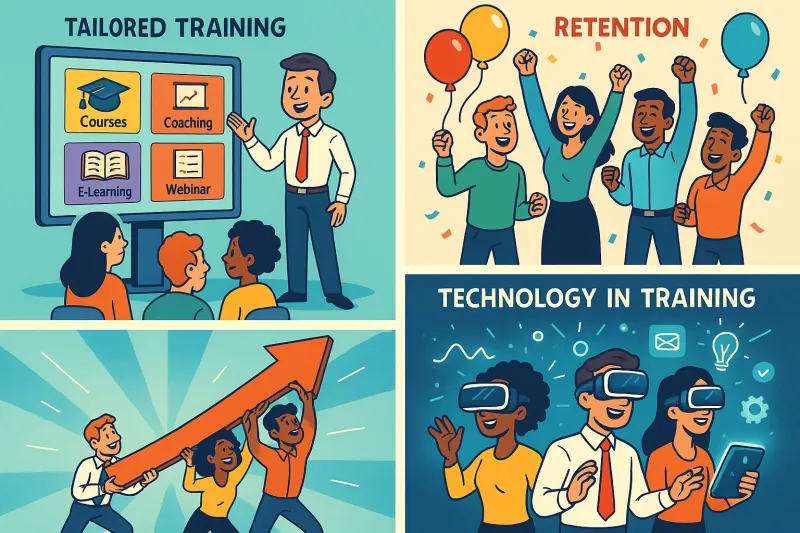
Photo: diverse employees workplace training technology learning professional development, via pastory.app
The rollout was, by every technical measure, a success. The new enterprise platform went live on schedule, the integrations held, and the dashboard looked exactly as the vendor had promised in the demo. What the project timeline did not account for — what it never does — was the 340 employees who now faced a fundamentally different version of their jobs and had received, in preparation, fourteen hours of training spread across two weeks.
Three months later, adoption metrics were dismal. Workarounds had proliferated. A quiet resentment had settled into certain departments. And the company had begun drafting job postings for roles that, with a different approach, its existing workforce might have been equipped to fill.
This is not an unusual story. In American enterprise, it is the default story.
The Transformation Paradox
Digital transformation, as it has been practiced by the majority of US companies over the past decade, operates on an implicit assumption: that technology can be deployed faster than people can adapt, and that the resulting gap can be closed through hiring. This assumption has driven enormous value for technology vendors, staffing firms, and executive consultants. For the workers caught in its wake, the calculus has been considerably less favorable.
The numbers tell a story that boardrooms have been slow to internalize. According to research from McKinsey, roughly 87 percent of executives acknowledge that their organizations face skill gaps currently or expect to within the next few years. Yet the same research consistently shows that training and development budgets, when measured as a proportion of overall technology investment, have not kept pace. Companies are spending aggressively to change what their people must do while investing modestly in helping them do it.
The gap between those two figures is where careers stall, morale erodes, and organizational capability quietly degrades.
Speed as a Cultural Value — and Its Casualties
To understand why workforce development has been so consistently deprioritized in transformation programs, it is necessary to examine what American corporate culture rewards. Speed is a virtue. Agility is a brand. The executive who delivers a platform migration in six months is celebrated; the one who advocates for an eighteen-month program that includes robust reskilling is perceived as an obstacle.
This cultural orientation is not irrational — competitive pressure is real, and technology windows do close. But it has produced a systematic pattern in which the human dimension of change is treated as a downstream concern, addressed after the technical work is complete rather than designed in from the beginning.
The consequences are visible in multiple dimensions. Productivity losses in the months following major technology deployments are well-documented and frequently attributed to the wrong causes. What companies categorize as change resistance or low adoption is often, more precisely, capability absence. Workers who have spent years developing expertise in a particular system or workflow are not being obstinate when they struggle with its replacement. They are experiencing a genuine competence disruption that takes time, structured support, and psychological safety to resolve.
For older workers, the experience can be particularly destabilizing. A 54-year-old accounts manager who has spent two decades mastering a legacy financial system does not simply absorb a new ERP platform through osmosis. The expectation that they will, or the quiet judgment that they should, reflects a failure of organizational empathy that has real retention consequences.
The Hire-and-Fire Cycle and Its Hidden Costs
When internal skill gaps become operationally visible, the default corporate response in the United States has been to hire externally rather than develop internally. This approach has a surface-level logic: external candidates arrive with the required skills already in place, eliminating the transition period. In practice, its costs are routinely underestimated.
The expense of replacing an employee — accounting for recruiting, onboarding, lost institutional knowledge, and productivity ramp time — is commonly estimated at between 50 and 200 percent of that employee's annual salary, depending on role complexity. For technical positions, the upper end of that range is conservative. When an organization cycles through waves of transformation-driven attrition and replacement, those costs compound rapidly.
Beyond the financial calculus, there is a cultural cost that balance sheets do not capture. Workforces that experience repeated cycles of displacement — watching colleagues exit while new hires arrive with different vocabularies and different assumptions — do not maintain high levels of engagement or discretionary effort. Trust erodes. Institutional memory walks out the door in the bodies of the people who carried it. What replaces them is technically capable but contextually thin.
Several sectors have begun to feel this acutely. Manufacturing companies that invested heavily in industrial automation and IoT infrastructure over the past five years are now discovering that the workers who understood their legacy equipment, its quirks, its failure modes, its undocumented tribal knowledge, are gone. The new hires who can manage the digital systems have no equivalent depth of operational context. The gap is different in character than the one it replaced, but it is no less significant.
Designing Development Into Transformation
The alternative to the current model is not slower transformation. It is smarter transformation — one in which workforce capability development is treated as a parallel workstream rather than an afterthought.
Organizations that have navigated this well share several characteristics. First, they conduct skills gap analyses before technology selection, not after deployment. Understanding what capabilities your current workforce lacks, and what it would take to develop them, should inform both the choice of technology and the pace of its rollout. Second, they design role evolution pathways that give existing employees a visible route into the new environment. Workers who can see a credible path forward are substantially more likely to invest in traversing it.
Third, effective organizations distinguish between training and learning. Training is an event. Learning is a process. Fourteen hours of classroom instruction before a platform goes live is training. A sustained program of structured practice, peer learning, coaching, and iterative application over several months is learning. The former checks a compliance box. The latter actually changes what people can do.
Finally, and perhaps most critically, successful organizations hold their transformation leaders accountable for workforce outcomes, not merely technical delivery milestones. When a program is declared complete at go-live, with no measurement of whether the humans operating the new system are actually proficient, the incentive structure guarantees the gap will persist.
A Different Kind of ROI
The argument for investing in workforce development during transformation is not purely humanitarian, though the humanitarian case is substantial. It is financial, strategic, and competitive.
Companies that retain experienced employees through technology transitions preserve institutional knowledge that cannot be purchased. They maintain morale in the broader workforce, which watches how colleagues are treated during periods of change. They reduce the recruiting and onboarding costs that accrue from high transformation-era attrition. And they build organizational learning capacity — the ability to absorb future technology changes more efficiently — that compounds in value over time.
The technology will continue to evolve. The pace of change is not going to moderate to accommodate human development timelines. But the organizations that will navigate that reality most successfully are not those that simply replace their people every three years. They are those that have decided, deliberately and structurally, that their people are worth the investment of being brought along.